Backcountry Fishing
Our remote Alaskan backcountry fishing adventures are offered to anglers that are looking for a unique Alaskan outdoor fishing experience. Whether you are a new or a seasoned angler, fly-fish or use traditional tackle, or just want to come explore the wilderness we welcome you!
Sockeye Salmon
Red or Sockeye Salmon are amazingly acrobatic and are an absolute blast to catch. You need not be an experienced fly fishermen to catch red salmon flyrods. Our guides are accustomed to working with beginners to professionals. We fish for Sockeye Salmon on the Kenai River & Kasilof River. In your free time, you can also try fishing for Sockeye Salmon from our private dock at the Lodge and all gear required is provided. The best way to catch Sockeye Salmon is using flies. The kind of fly is not critical, the only important thing is that the fly flow with the current near the bottom. Sockeye salmon do not strike a fly…it is up to the angler to get the fly into the mouth of the fish swimming upstream. Our guides will teach you the technique so you will be successful.


Rainbow Trout
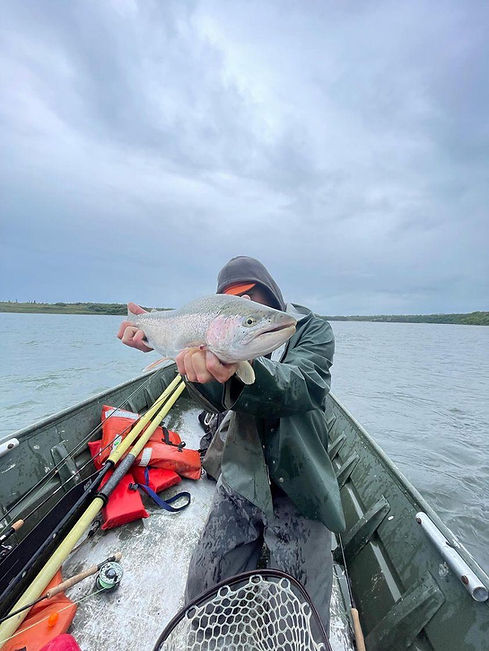
The New Halen river drainage provides some of the most exciting rainbow trout fly-fishing in Alaska. Throughout the year, Alaska’s New Halen River fly fishing produces trophy rainbow trout and Dolly Varden for anglers of any skill level. Fly-fishing on Alaska’s New Halen river has yielded Rainbow trout of up to 15lb. More typical is in the 2 lb. to 6 lb. variety; however, rainbow trout of up to 10 pounds are not uncommon. In Alaska, many locals love fly fishing for rainbow trout For those of you whom are not avid fly fishing people, DON’T FEAR. You need not be a fly fisher to catch these beauties. They will also take flies presented using spinning tackle. The fishing is equally as good using fly fishing gear or spinning tackle. The most popular flies are wet flies: either “flesh” or “egg” patterns or a combination of both. Something in the range of a 6 wt. rod is what most people use. Once again, in addition to the spectacular trout
Northern Pike
Northern Pike are abundant in the nearby scenic lakes. This area is accessible by boat and portage within 20 minutes of the lodge. Large numbers of fish 2-4 lbs with some exceeding 10 lbs. can be taken by various techniques in these secluded glass-water lakes. Pike are voracious feeders and provide hot action on top-water lures and flies throughout the summer. Low light periods of the day and early and late season provide the best times to chase pike. Overcast and rainy days allow for consistent fishing all day long. This is a great supplementary side trip to your Alaska salmon and trout fishing vacations.
The lake is a beautiful, peaceful place that is a whole different world compared to wade fishing our local river system. You can set up a trip to our area pike lakes with your guide at any time during your stay.
Many people that have never pike fished before will love this experience! For veteran lakes fishermen, this is still a unique experience that you should include as part of your complete Alaska fishing experience. Most of the pike that we catch are targeted in less than 4 feet of water. It's a great kids venue as we literally see every fish attack our lure or fly from the surface or just underneath. Northern pike are notorious for following lures right to the boat and striking within an arm's reach! Blend the shallow-water northern pike fishing in the lake with excellent trout and grayling fishing on our main river.

Arctic Grayling
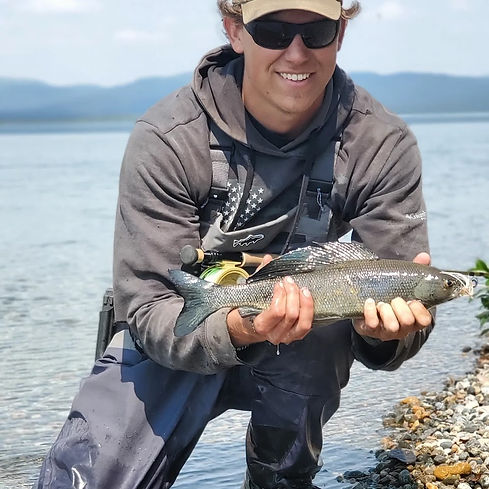
Arctic grayling are a premier, accessible sport fish in Alaska, characterized by their large dorsal fin and willingness to hit flies or small lures in cold, clear streams, rivers, and lakes
Fly Fishing: Use 3-5 weight rods with dry flies (Elk Hair Caddis, Adams, Mosquito) or nymphs (Beadhead nymphs).
Spin Fishing: Use light/ultralight rods with 4-6 lb test line. Effective lures include small spinners (Panther Martin, Blue Fox), small spoons (Krocodile), and tiny jigs (1/8 to 1/4 ounce) in white, black, or metallic colors.
Grayling often congregate in eddies behind boulders, logs, or at the transition of fast riffles to deep, calm pools.
Tactics: Cast slightly upstream, allowing the lure or fly to drift naturally, and use, or mimic, a "dead drift" for feeding fish.